Ravan Hasanov, Executive Director of the Baku International Multiculturalism Center, gave an exclusive interview to The Daily Baku

Ravan Hasanov: Multiculturalism is not a concept for Azerbaijan but a philosophy of life – EXCLUSIVE INTERVIEW
Azerbaijan has historically evolved as one of the rare places where diverse ethnic and religious communities have coexisted in peace and mutual respect. Today, tolerance and multiculturalism are not only key elements of social relations in the country but also among the core pillars of state policy. To explore this topic in greater depth, The Daily Baku interviewed Ravan Hasanov, Executive Director of the Baku International Multiculturalism Center. The interview offers a detailed interpretation of Azerbaijan’s multicultural model, the protection of cultural heritage in the post-conflict period, the transmission of these values to younger generations, and the messages Azerbaijan conveys to the world.
– Tolerance in Azerbaijan is a way of everyday life. Jews, Lezgins, Udins, and other peoples have lived together in one society for many years without problems. In your view, what are the main reasons behind the formation of this environment, and what distinguishes Azerbaijan from many other countries in this regard?
– The transformation of tolerance into a way of daily life in Azerbaijan is not accidental; it is the result of a sustainable environment shaped by the convergence of historical, social, and political factors. The country’s geographical location – at the crossroads of East and West, where different civilizations and cultures intersect – has for centuries made the coexistence of diverse ethnic and religious communities inevitable. Jews, Lezgins, Udins, Talysh, Avars, and other peoples have lived on these lands for generations not merely side by side, but based on mutual respect and trust. Over time, this coexistence evolved into a life philosophy within society that recognizes tolerance as the norm and diversity as a source of enrichment.
One of the main reasons for the formation of this environment is that multiculturalism represents a way of life for the Azerbaijani people. In Azerbaijan, tolerance is not an artificially constructed concept; it is naturally embedded in family relations, neighborhood life, traditions, and everyday communication. People belonging to different religions and ethnicities share the same spaces, celebrate each other’s holidays, and stand together in times of sorrow, which ensures deep social harmony within society.
At the same time, multiculturalism in Azerbaijan is not limited to a model of social behavior; it is a key and purposeful direction of state policy. The Azerbaijani state regards multicultural values as a strategic priority and implements this policy consistently. The Constitution enshrines equality of all peoples, freedom of religion, and the protection of cultural rights. Alongside this, extensive legal and institutional reforms have been carried out to safeguard and promote multiculturalism, relevant state institutions have been established, and programs and projects have been implemented. This demonstrates that tolerance is ensured not merely at the level of declarations, but through real governance mechanisms.
What distinguishes Azerbaijan from many other countries is the state’s particular commitment to preserving the languages, traditions, and beliefs of all peoples who have historically lived within its territory. This commitment is not only a principled stance but is also accompanied by concrete actions. Education and publications in the languages of national minorities are supported, religious places of worship are preserved and restored, and material and organizational assistance is provided for cultural events. At the same time, the spiritual values of these communities are respected by the state and presented as an integral part of the country’s shared cultural heritage.
Ultimately, tolerance in Azerbaijan rests on three main pillars: the people’s way of life, the state’s consistent and well-considered policy, and a strong legal and administrative framework created to implement this policy. It is precisely this unity that makes the multicultural environment in Azerbaijan sustainable, vibrant, and exemplary, and serves as the key factor distinguishing the country from many others in this field.
– Today, globalization pushes cultural differences into the background in many countries. In Azerbaijan, however, diverse cultures are preserved and sustained. How does Azerbaijan maintain this balance?
– Globalization processes in many societies promote a uniform lifestyle, similar values, and behavioral patterns, leading to the gradual erosion of cultural differences. Azerbaijan, however, has chosen a different path, becoming one of the rare countries that manages to benefit from globalization while preserving national and cultural diversity. This balance can be explained by several key factors.
First of all, cultural diversity in Azerbaijan is not viewed as an alternative to globalization, but as its integral and complementary component. The state and society perceive integration into the global world not as a rejection of identity, but as an opportunity to present national and spiritual values on an international scale. As a result, Azerbaijan remains open to global processes while simultaneously relying on its historical roots and cultural heritage.
There is a strong sense of cultural self-awareness within Azerbaijani society. Despite the impact of globalization, diversity is perceived not as a national threat but as social wealth. In this sense, the preservation of different cultures is not only a state initiative but also a nationwide value supported by society. People regard participation in the global space while preserving their cultural identity as a natural process.
I believe that the Azerbaijani model is built on the principle of selective globalization. Global values and technological innovations are accepted, but they are adapted to the local cultural context. This approach prevents the erosion of national and spiritual values and transforms globalization from a process of cultural homogenization into one of mutual enrichment.
– After the liberation of Karabakh, Azerbaijan is restoring not only mosques but also churches and Albanian temples. How do you interpret these steps in terms of Azerbaijan’s tolerance and multiculturalism policy, and what message does this approach send to the world?
– The restoration and reconstruction process carried out after the liberation of Karabakh reflects not only physical infrastructure, but also Azerbaijan’s system of values and its cultural and political outlook. In this context, the restoration of churches and Albanian temples alongside mosques should be regarded as a logical and consistent continuation of Azerbaijan’s policy of tolerance and multiculturalism.
First, these steps demonstrate that for Azerbaijan, religious and cultural heritage is not selective but holistic. Karabakh is not only a historical territory of Azerbaijan but also a space bearing the traces of various civilizations and religions. The state regards all religious and cultural heritage that existed in these areas – regardless of ownership – as a universal and national treasure. This approach makes it essential to preserve Christian churches and Caucasian Albanian temples alongside mosques.
Second, this process shows that Azerbaijan’s multiculturalism is an unchanging principle not only in times of peace but also in the post-conflict phase. Against the backdrop of the destruction of religious and cultural monuments during years of occupation, Azerbaijan’s post-liberation restoration policy proves that it is based not on revenge or hatred, but on law, justice, and the restoration of historical memory. This clearly demonstrates that tolerance is not situational, but a state policy rooted in deep values.
Third, the restoration of churches and Albanian temples reflects Azerbaijan’s determination to preserve its history as it truly is. The heritage of Caucasian Albania is an important component of the region’s multi-layered historical identity, and its preservation is both a scholarly and moral responsibility, as well as a matter of cultural justice. The state’s special attention to this heritage shows that Azerbaijan pursues an inclusive memory policy grounded in historical truth.
The key message this approach sends to the world is clear: Azerbaijan does not turn religious and cultural heritage into an instrument of conflict. On the contrary, it presents cultural heritage as a means of peace, dialogue, and mutual respect. The parallel restoration of monuments belonging to different religions in Karabakh demonstrates that multiculturalism in Azerbaijan is not a declarative slogan, but a practical policy confirmed through concrete actions.
Ultimately, the restoration of mosques, churches, and Albanian temples within a single conceptual framework in Karabakh is one of the strongest manifestations of Azerbaijan’s model of tolerance and multiculturalism. This policy demonstrates to the international community that Azerbaijan remains committed to a humanistic, inclusive, and peace-oriented approach even in the post-conflict period, positioning the country as an exemplary model in the field of cultural heritage preservation.
– Today, social networks have a significant impact on the worldview of young people. In your opinion, how should tolerance and multicultural values be transmitted to the younger generation so that this tradition is preserved in the future?
– Today, social networks have become one of the main spaces shaping the worldview of young people, creating both challenges and new opportunities for the transmission of tolerance and multicultural values. Passing these values on to future generations requires not only traditional methods, but also a thoughtful and systematic approach using modern communication tools. I believe that tolerance and multiculturalism should be presented to young people not as abstract concepts, but as lived experiences rooted in Azerbaijan’s reality.
Real stories, visual content, and personal examples reflecting the daily lives, joint activities, shared celebrations, and social solidarity of various ethnic and religious communities in Azerbaijan should be shared on social media. The state’s multiculturalism policy must be explained in a language that is understandable and engaging for young people. Connections should be established between educational programs and social media content, ensuring that multicultural values taught in schools and universities continue across digital platforms.
In this regard, encouraging young people themselves to become content creators – speaking about tolerance through blogs, podcasts, and short videos – is particularly effective. At the same time, combating hate speech, disinformation, and radical narratives in the digital environment is of critical importance. To preserve Azerbaijan’s tradition of tolerance, young people must be equipped with critical thinking skills and a culture of respect for differing views. In this process, awareness-raising initiatives by both state institutions and civil society play a vital role.
– What does leading the Baku International Multiculturalism Center personally mean to you, and what are your near-term plans given the Center’s active role in recent years in preserving this unique value of Azerbaijan, transmitting it to younger generations, and representing it internationally?
– Leading the Baku International Multiculturalism Center represents not merely an administrative position for me, but a great moral responsibility and an expression of the trust placed in me by President Ilham Aliyev. Multiculturalism for Azerbaijan is not just a concept, but a way of life formed over centuries and today an essential component of the state’s governing philosophy. Leading this Center means carrying the mission of preserving, developing, and properly presenting the unique value of our people to the world.
The growing interest in the Center’s activities in recent years is not coincidental. The Center structures its work not only within a theoretical framework, but around practical, applied projects with international resonance. The teaching of the course “Azerbaijani Multiculturalism” at local and foreign universities, international summer and winter schools, scholarship programs for foreign researchers, publications, and academic conferences all demonstrate the Center’s systematic and sustainable approach. Through these initiatives, multiculturalism has become a subject of academic and intellectual discourse not only within the country but across various regions.
One of the Center’s key missions is to transmit Azerbaijan’s multicultural values to younger generations. Our activities in this area aim to involve young people not merely as listeners, but as active participants in the process. Through dialogue formats, trainings, regional visits, and social projects, multiculturalism is presented to them not as an abstract idea, but as a real experience of everyday life. Our goal is for young people not to perceive these values as a ready-made model, but to integrate them naturally into their worldview.
At the international level, the Center continues to present Azerbaijani multiculturalism as an alternative and successful model. Conferences held in different countries, joint projects with partner institutions, and participation in academic and cultural platforms show that Azerbaijan’s experience attracts global interest. Particularly in areas such as interfaith and intercultural dialogue and the protection of cultural heritage in post-conflict periods, the Center’s position has become part of the international discourse.
Our near-term plans focus on further deepening this work. First and foremost, we plan to expand the geographical scope of research on multiculturalism and strengthen academic cooperation in new regions. At the same time, we are developing new youth-oriented projects through digital platforms, including online education and multimedia content, to ensure that multicultural values are effectively promoted in the modern information environment.
In parallel, amid the ongoing reconstruction processes in Karabakh and East Zangezur, prioritizing scholarly and public discussions on the preservation of multicultural heritage is also among our key objectives. Creating platforms with the participation of international experts and presenting Azerbaijan’s tolerance policy in the post-conflict period to the world are central goals in this direction.
For me, leading the Baku International Multiculturalism Center means respect for the past, responsibility to the present, and confidence in the future. Our main objective is not only to preserve Azerbaijan’s multicultural value but to pass it on to future generations as a living, evolving, and globally recognized model.
– When meeting with people from various communities, what impressions do you take away, and how do they evaluate these interactions?
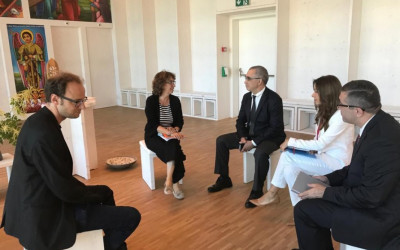
– Meetings with representatives of diverse religious and ethnic communities are not merely official contacts for me; they are valuable moments of interaction in which I directly experience the living manifestation of Azerbaijan’s multicultural environment. I usually leave these meetings with one shared feeling: trust and mutual respect. This trust among people and toward the state is the most genuine and tangible indicator of Azerbaijan’s multicultural model.
What strikes me most during conversations with community representatives is their sense of belonging as an inseparable part of society. While preserving their national, religious, or cultural identities, they emphasize their pride in being citizens of Azerbaijan. This shows that multiculturalism is not limited to legal guarantees, but has also evolved into a psychological and social environment.
Feedback from communities generally falls into two main areas. First, they highly appreciate the state’s attention and support for their languages, beliefs, and cultural heritage. The preservation of places of worship, organization of cultural events, and access to education and publishing opportunities are cited through concrete examples, demonstrating that implemented policies address real needs.
Second is their assessment of the activities of the Baku International Multiculturalism Center. Communities perceive the Center not merely as a coordinating body, but as a platform that listens to them, fosters dialogue, and jointly discusses challenges. Taking their proposals into account and involving them in joint projects further strengthens trust in the Center.
You know, after every meeting with different communities, I become even more convinced that Azerbaijani multiculturalism is a value that lives within real life, unites people, and strengthens society.